


Could delivery robots help pay for better city sidewalks?
Camron Bridgford was eating dinner outside at a Miami restaurant when she saw a strange sight: two sidewalk delivery robots in a standoff, each one blocked by the other.
"One finally had to back out and let the other one through," says Bridgford, senior principal at Cityfi, who worked on a 2021 landmark sidewalk delivery robot pilot program in four cities.
In the five years since that program, sidewalk bots, dubbed Personal Delivery Devices or PDDs, have gotten smaller and slower as the market consolidates, Bridgford tells Next City. But the PDDs are still far from perfect: Even as they roll into new cities like Vancouver, bots are still smashing into glass bus shelters and getting stuck in snow.
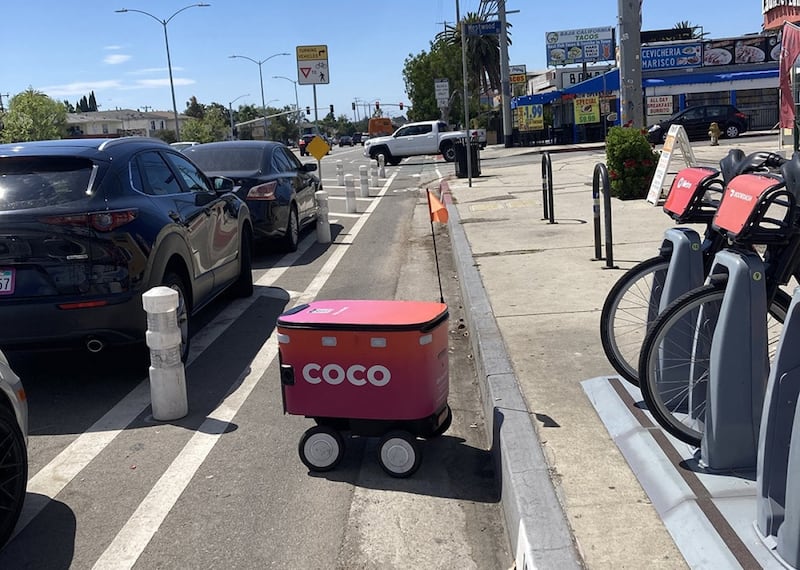
Companies like Coco Robotics, Serve Robotics, Starship Technologies, and Robot.com say that their devices are right-sizing food delivery and offering an alternative to expensive and polluting motor vehicles that clog the streets. Critics counter that they block pedestrians, especially people using wheelchairs or other mobility devices, from using the sidewalk.
That's on top of existing sidewalk regulation challenges, including questions over who pays for maintenance and repairs.
“You’ll have residents at community engagement events saying, ‘Why are we worried about this when I want my kid to be able to walk to school, and there’s broken sidewalks, and they can’t even get there safely that way?’” Bridgford says. “Tech can come in and want to solve issues. But if you have things like missing sidewalks, you have poor curb ramps, you have maintenance issues — those ultimately were the biggest structural barriers.”
Nor have cities figured out how to manage or price all the competing interests at the curb, including goods delivery, sidewalk bots, and parking, she notes.
As the PDD market consolidates, cities like Washington, D.C. and West Hollywood are working with companies to track sidewalk issues and raise new sources of revenue. Could delivery robot companies sharing data and revenue to help bring about accessibility improvements be the key to good robot-city relations — and to more human-friendly cities?
Maylin Tu for Next City
Sidewalk robots as disability allies?
For all the backlash, complaints about robots are quite rare in Santa Monica, says Trevor Thomas, who manages the city’s PDD program. Coco, the sole operator, deploys 50 to 100 bots.
“Every once in a while, we get a complaint of somebody who has been treated brusquely by a PDD on the sidewalk,” he says. “But it’s honestly pretty infrequent that we see one of those complaints.”
Representatives from different cities have been meeting to talk about PDD policies and how to regulate the public-right-of-way. Top of mind are data-sharing requirements, something that cities are still figuring out. In contrast with autonomous vehicle companies like Waymo, sidewalk robot companies have proven more willing to provide cities with data — including sharing information to help local governments target accessibility issues.
At least two operators, Coco and Robot.com, are investing in tools and partnerships to make sidewalks more accessible for people with disabilities.
Coco recently announced its partnership with GPS app BlindSquare to provide real-time navigation for people who are blind or low-vision. As Coco bots navigate sidewalk hazards like poorly parked e-scooters and cars blocking the sidewalk, they can relay that information to the app. Once the obstacle is gone, BlindSquare users can mark the obstruction as cleared.
“We’re all helping each other navigate the sidewalk space,” says Carl Hansen, head of government relations at Coco. He stresses that the data that robots collect is “completely anonymized.”
The feature started in Helsinki with a grant from the European Union and is live in four U.S. cities: Los Angeles, Chicago, Miami, and Jersey City.
Robot.com, formerly known as Kiwibot, is collecting detailed sidewalk obstruction data in D.C. and Arlington, Virginia.
“We have come to understand that sidewalks are sacred,” says co-founder David Rodriguez, who takes a hardline approach to sidewalk accessibility. If a sidewalk is too narrow for a robot to pass someone using a wheelchair, then robots shouldn’t be on that sidewalk: “We don’t think that’s respectful,” he says. Rodriguez declined to specify a minimum width.
The sidewalk mapping program tracks sidewalk issues by type and also rates the severity of each issue. Last year, Robot.com captured about 35,000 total data points, including ADA hazards like dips and heaves in the sidewalks.
D.C. is requiring this information from its only operator, Robot.com, says Rodriguez. Today, more cities require operators to share data using Mobility Data Specification (MDS) to track where robots are operating in the public-right-of-way. So far, cities don't appear to be using sidewalk data to make accessibility improvements.
One exception: Three curb ramps on bustling Abbot Kinney Boulevard in Venice, Los Angeles. Coco, which is based in Venice, found that the missing curb ramps turned certain blocks into “islands” for people using wheelchairs, scooters and strollers — and for the company’s robots.
“Rather than prioritize fixing [all the ramps], we could say, ‘Hey, based on our routing technology, if you added one here, here and here, this whole area becomes accessible to wheelchair users and those that need curbs, like Coco,” says Hansen.
The path to repair, however, followed the usual pattern: Coco reached out to the local council district office, who in turn coordinated with city departments to add the curb ramps.
In the future, sidewalk bots could serve as pedestrian guinea pigs, flagging issues to cities or even changing conditions in real-time. In Helsinski, Sweden, Coco is partnering with Swarco, a traffic light company, to track the number of pedestrians waiting at intersections.
“[The robot] can autonomously communicate with the traffic light. And if there’s some threshold of crowd waiting, [it can] add extra time to the pedestrian crossing so that more folks have to have time to get across at that intersection.”
Where robots are paying for curb ramps
Sidewalk data might be valuable, but what about cold, hard cash to repair sidewalks? West Hollywood is implementing what might be the first program of its kind to use fees from robots to improve sidewalks.
When the PDD pilot first began in 2020, the city’s license agreement for operators didn’t include any proverbial “sticks,” explains Paige Portwood, associate planner for West Hollywood. The new contract includes annual fees and penalties for ADA and geofencing violations.
West Hollywood also requires Serve and Coco to share advertising revenue at the rate of $4 per device per day. All advertising revenue, fines, and program fees will go into a special fund for accessibility improvements.
“We’re really excited about that,” says Portwood. “It’s only been three months since we’ve implemented this kind of model.”
It's still too early to tell how much the new program will raise for sidewalks, but a December report estimates it could generate $40,000 to $80,000 per year.
Meanwhile, companies are counting on ad dollars to make sidewalk delivery competitive with more traditional forms of delivery. Hansen believes that revenue sharing with local governments needs to be “right-sized.”
“If those dollars are linked back with infrastructure improvements and other things in the pedestrian space, that can be very cool,” Hansen says. “We would love to see stuff like that.”
There is currently no mechanism for an operator to directly fund a curb ramp, as cities struggle to come up with money to fix crumbling sidewalks.
Instead, Coco and Robot.com are banking on the value of the data that they share with cities.
What data might robots capture in the future that cities could use to improve the public realm? Cities’ ability to receive and process data is only becoming more sophisticated.
“It’s pretty wild what the devices can do,” says Portwood. “They have sensors, they have cameras.”
At a recent transportation tech summit, someone suggested mounting air quality devices to the robots.
“Cities often have these, but they’re mounted up pretty high,” Hansen says. “They’re like, ‘Man, having this on a Coco as it traveled through the city would be really interesting, because you’re at the same height as a child, breathing in the same air.’”
This story was produced with support from the Solutions Journalism Network’s How Government Responds Innovation Fund.
This story was produced by Next City and reviewed and distributed by Stacker.